As a photographer it’s allways interesting to get feedback on your photos, your style, and what people like the most about the photos you are taking. I consider my style to be fairly set. I like to think if you viewed my photos as one large collection there are some general observations than can be made, and a loose style could be defined.
Over time it is interesting to view the Flickr stats to see what is popular, or has had the most views. Now of course older photos will slowly build up more views, so older photos will generally have higher numbers. But it’s also true to say than unpopular photos will drop off in hits over time. Consistently viewed photos will continue to grow, and do stand out in stats.
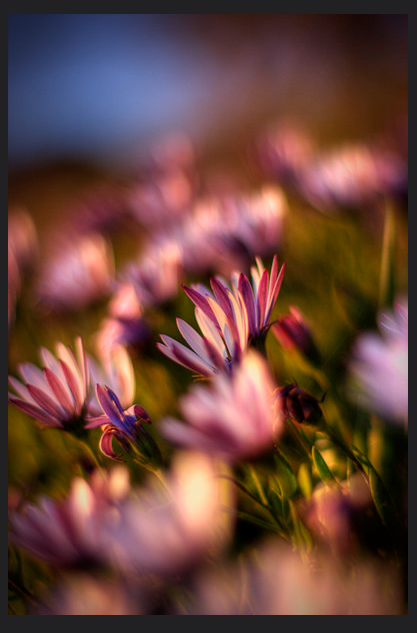
Lost of views can be because of many factors of course, such as one photo being referenced by an enternal source. but it’s allways intereting to see whats popular. So what is my most viewed photo? Well to my supprise it’s an unassuming, somewhat very basic picture of some flowers at sunset:
There is a lot of ‘noise’ around the A7R V at the moment, with a lot of people saying that it’s low light capabilities are very good considering it’s 61MP sensor count. Of course most of the high ISO testing for noise so far hae been to do with fairly short shutter speeds, considerably less than one second. But is it going to be any good for exposures above 1 second?
So I have tested the camera and the results are below, but before I go into them there are a few things to consider, that even my testing is unable to determine. Firstly My tests do not involve any subject matter they only test pure sensor noise or a dark frame. How the sensor will be able to use the avaliable light and the results are not tested. Which leads to the second point:
Pixel size or light “Buckets”
In high Megapixel cameras the pixels or ‘buckets’ for collecting light are getting much smaller. So each bucket is getting less light. For example an A7S has individual pixels that are 8.4 micros wide, where as the new A7RV are 5.4 micros. This reduction of avaliable light to individual pixels means there is less signal or level for “light” recorded by the pixel to be read and as a result the signal to noise level is worse.
The testing that I perform only tests the pure noise when the sensor is not detecting light, and how much signal there is at a given light level or exposure is not tested, so Signal to Noise S/N is not tested.
The Results:
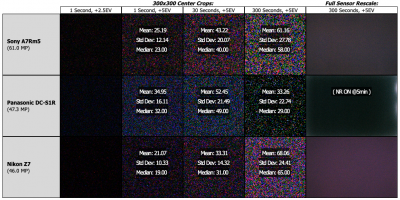
The A7R V is by far the best high MP count sensor I have tested. with results very close the Nikon Z7 with 47MP. It Also outperforms the S1. Keep in mind that both the S1 and Z7 are both previous generation cameras, and I have not tested newer models. None the less, these are very impressive results.
The A7R V unlike the A7R IV has a new feature, that was sorely missing from the previous model, and this is the ability to shoot smaller RAW files. Sony have introduced RAW Medium (26MP) and RAW Small (16MP). Both of these sizes are down-sampled images taken from the full sensor.
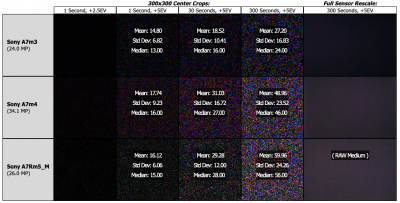
Because the Medium sized RAW is 26MP, still quite a large size, larger than even the A7III I decided to run the tests again from these files. It’s worth remembering at this point that downsampled images can only work with the avaliable data which will have the signal to noise related issues mentioned above.
The results were good and the reduction of noise from the 61MP image was significant, and place the final RAW file on par with the A7III and A7IV. When you consider there are 2 extra MP it’s an impressive result to be so close to the A7III, which is still considered to be one of the best low light cameras avaliable. Having said that it is worth noting that the longer the exposure the less benefit there is from downsampling, I suspect due to more noise being introduced into the image that the downsampling can’t deal with as the S/N gets worse.
So if you can afford an A7R V over the A7 V I guess you get the benefit of having a High MP camera as well as having the ability to downsample for much better results for some long exposure work.
If you would like to compare the A7R V to other models you can do so from the Sensor DB here.
Better late than never they say. It has been some time since I uploaded some sensor results to the Sensor Database. Results for the A7 Mark 4 are good, not as good as the Mark 3, but that is to be expected with more Megapixels.
Results at 1 second places the camera in the top rankings, but performance drops off with longer exposures compared to some other models. Still overall very impressive.
Check out the results for yourself in the Sensor DB.
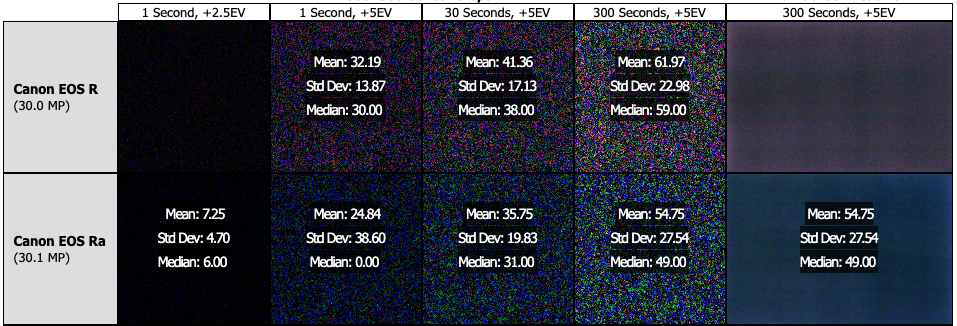
The Canon EOS Ra is aimed at the Astrophotography community. It’s main difference compared to the normal R model is the modification on sensor IR filtering to produce better images for deep nebulae.
“Positioned in front of the CMOS imaging sensor, The EOS Ra’s infrared-cutting filter is modified to permit approximately 4x as much transmission of hydrogen alpha rays at the 656nm wavelength, vs. standard EOS R cameras. This allows for a higher transmission of deep red infrared rays emitted by nebulae, without requiring any other specialized optics or accessories.” – Canon Website
So aside from this change is the sensor any better when compared to the normal R model? Well the short anwser is yes, it is better than the normal R model. The Ra is consistently Better accross all the exposure lengths:
The Camera still lags behind the competition in regards to general noise at one second and appears well down the list, and slightly further at 30 seconds. However it is possibly Canon’s best performer when taking into consideration the MegaPixel count of the sensor.
At 300 seconds or 5 mins the camera does perform better, given the MP count it performs well when compared with other models. It is now somewhat closer to the top of the list. It does not appear to be doing any aggressive NR, as I would expect having the ‘a’ tag. Some of the better performing models at 1-30 seconds fall over at 300 seconds due to the sensor getting too hot. The Ra does not appear to have that problem. It’s also worth noting that the edges of the sensor are holding up better than than the R model, again possibly due to better thermals.
So overall it’s better than the R, and Canon may be selecting the Best sensors for Ra conversion. And the noise is linear and consistant for longer exposures. Check how it compares to other models in the SensorDB youself.
The Panasonic S1 sensor is awesome, I suspect in part as it uses the same Sony sensor the A7III uses. There is not a lot difference between the tested results for these cameras.
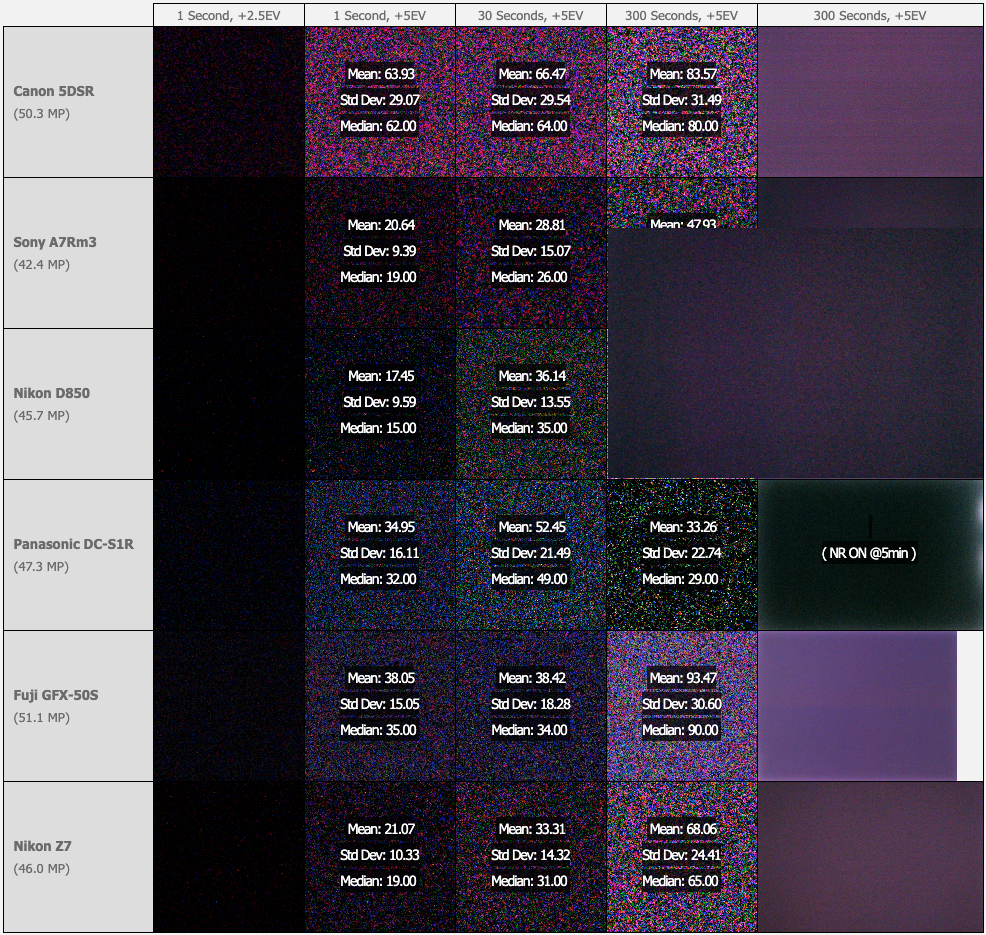
The S1R is, well, different. The first sign there is no shared sensor with any Sony camera is the MP count. Sitting at 47.3 it is quite unique in the 40MP+ space.
So how does it compare in the 40MP plus space? Well I’m not going to lie, It’s not as good as the competition. Canon still performs the worst, and assuming the S1R is not doing any in camera NR it is better than the GFX-50S at 1 second, however at 30 seconds the GFX is better.
At 5 minutes (300 seconds) the noise reduction kicks in which is clearly visible. It looks very similar to the Fuji and Olympus cameras and their NR algorithm. The noise mean drops below the 1 second results at 5 minutes and the noise colour profile changes significantly.
There is no point me comparing it to all the other models in the 40MP+ space as all are better for low light / long exposure work based on my basic test, at least from a noise perspective. In fact older models such as the A7RII seem to perform better. However, how the camera performs in regards to dynamic range I can not say.
What I will say is this camera is a classic example of why I do these tests. Dx0 has this camera equal or above most models for overall image quality. While this may be true for standard exposure times under relatively normal lighting, it is not true for extremely low light and long exposures. For Astro Photography or any other long exposure work the field is nowhere near as close.
So for long exposure work, this is probably not the droid you are looking for.
There has been a lot chatter about the A7 mark 3. Both the previous models were excellent low light performers, although there was some discussion in the Astro community they were eating stars. With the introduction of a BSI sensor could this be the camera for you?
Having recently tested the Panasonic S1 I was very interested to see how the A7 III performs, as most people are saying it’s currently a 2 horse race between these two cameras.
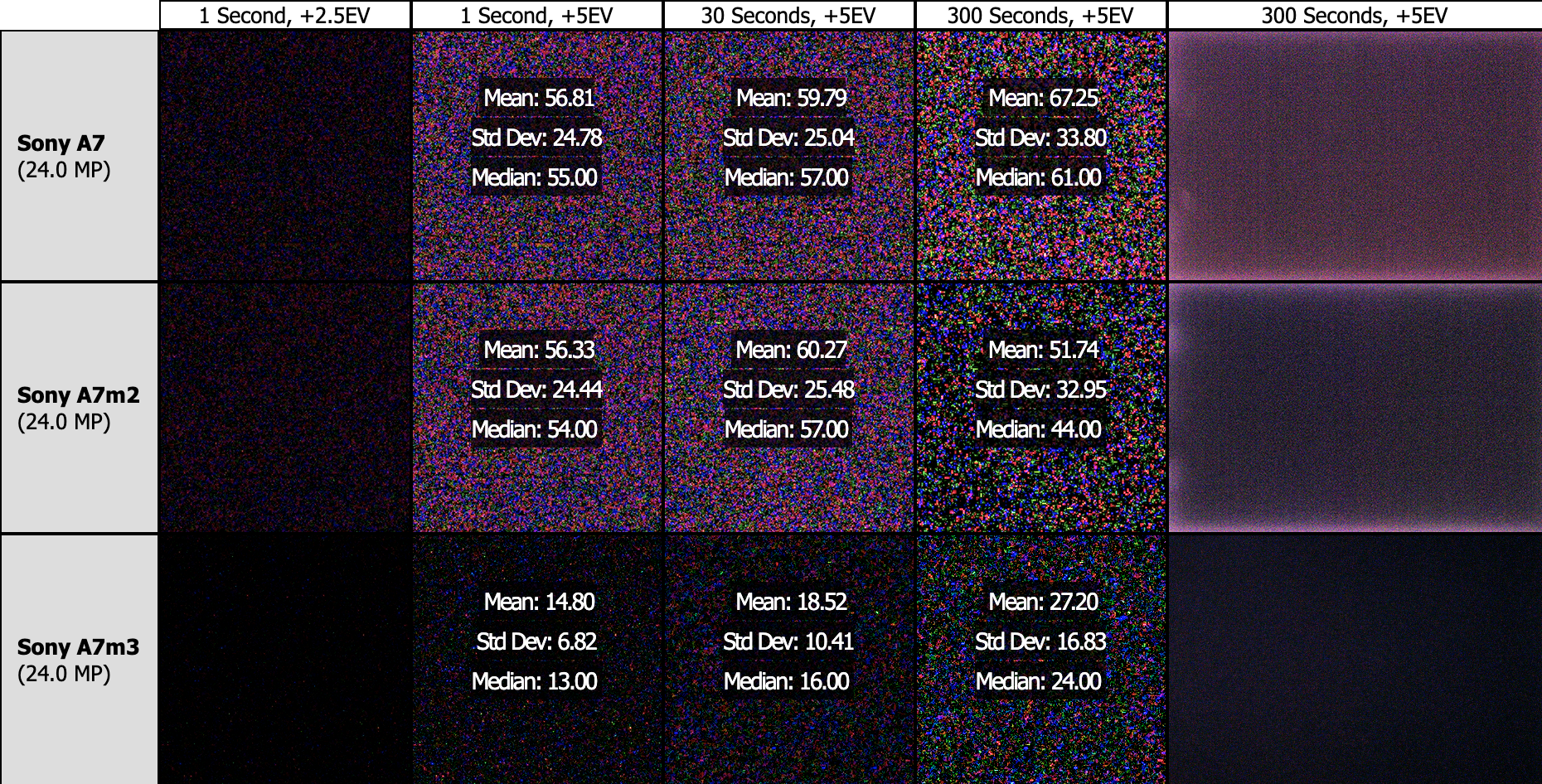
Well I happy to say the A7 performs very well, It’s clear that the BSI sensor is much more uniform than previous models and it has significantly less noise.
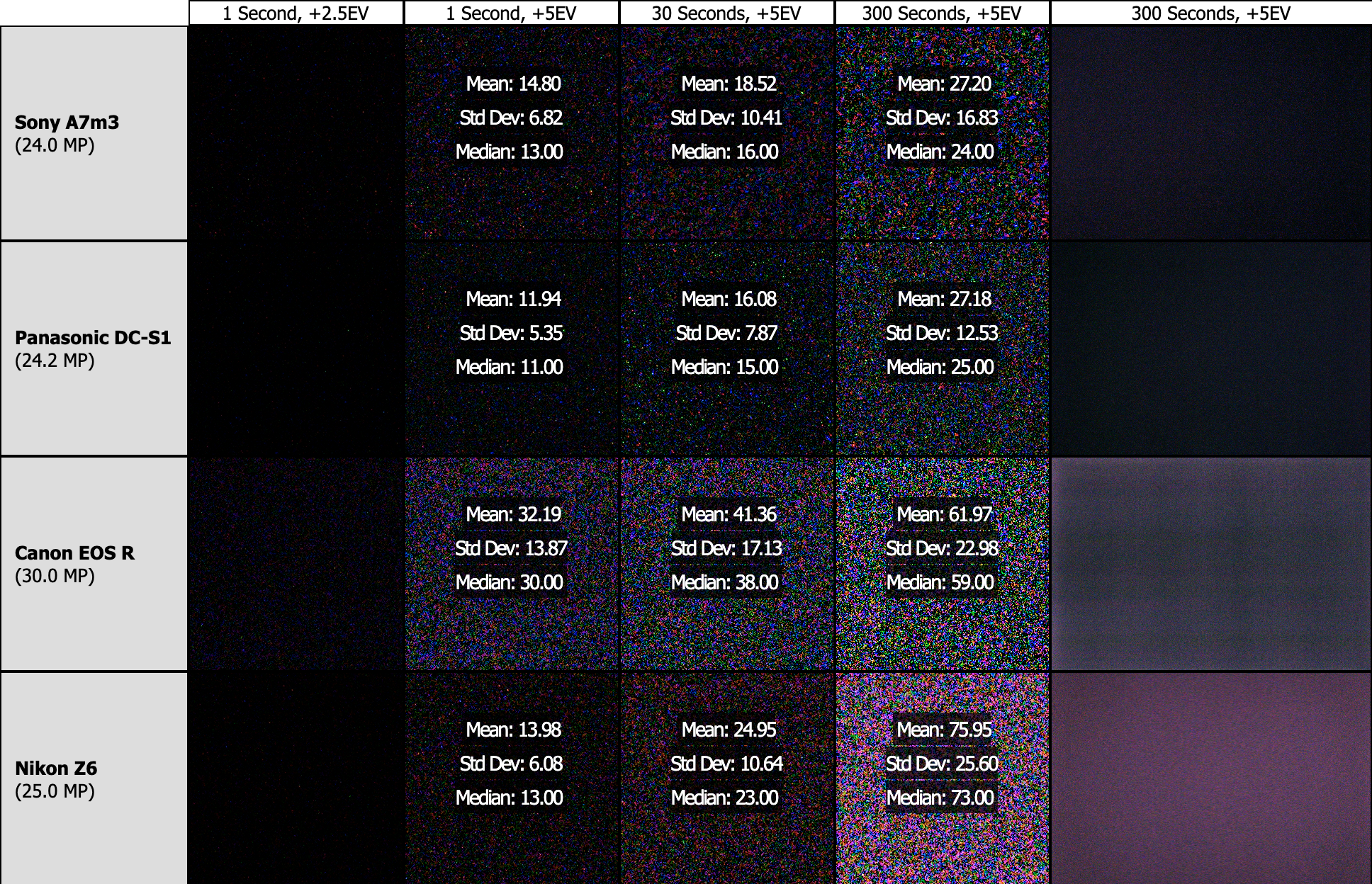
When comparing it to it’s competition it stacks up very well. It performs very close to the S1, and surprisingly at 5 minutes there is almost nothing in it. The EOS R is the worst of the pack and the A7III is significantly better right across the exposures tested.
I am not sure if the Z6 and the A7III share the same sensor. Getting 100% confirmation on this is very hard, some articles are saying they are the same, while in others the number of raw pixels is slightly different, so maybe they are not. If they are then the 5 minute exposure time could show aggressive NR from Sony. However there have reports that the A7III is not suffering from the star eating problem that previous models had, well not completely it depends on what you read, but it’s better. So you can draw your own conclusions about the Z6 and the A7III sharing the same sensor.
It would be more consistent to conclude the S1 and A7III share the same sensor than the Z6. With many saying this is the case less with only the phase detection pixels removed in the S1. The difference in noise could easily come down to RAW images algorithms, and sensor production variation. It will be interesting to see how the A7RIII and S1R compare.
In my opinion if you currently own Sony gear the upgrade path is a no brainer, the A7III. if you don’t other factors such as cost, lens availability and other camera features are more likely to be a factor if you are leaning to the S1.
It’s also worth noting that ensuring testing temperature is very difficult and this or a future firmware upgrade could easily tip the scales to either the A7III or the S1 or even the Z6. What can be done with a firmware upgrade is amazing. Either way both the A7III and the S1 are excellent long exposure performers and should perform very well.
If you would like to find out more about the Sensor DBclick here.
It has been a while since the Sensor Database has been upgraded, and it was time with the recent additions of some never sensors.
New features include a better layout with less clutter for comparing models. I have also added pop-up images to allow users to see a true 1:1 view of the sensor noise, rather than a 50% browser rescale. These new features will allow for better comparisons as sensors continue to improve.
A friend of mine recently purchased an S1, so it was time to test. I must say I’m pretty impressed. The low light sensitivity is generally one par with the Nikon Z6 for what most would consider “Sport” low light photography. Even Dx0 only shows a 4 point (0.011%) improvement on the Z6. Depending on the body you get it could easily fall either way.
So whats so impressive about this camera I hear you say? well, when you start to push this camera to exposures in excess of 1 second at ISO 3200 something very interesting starts to happen. The S1 does not seem to deteriorate any where near as quickly as the competition. At 300 seconds the noise is only slightly worse than the Z6 is at 30 seconds.
The S1 at 300 seconds performs better than the Canon RP at 1 second. Ouch, thats got to hurt Canon. Panasonic have clearly overshot the moon with their new Venus Engine processor and sensor.
S1 v the competition.
The noise profile looks to be “normal”, and I does not look like there is any aggressive NR filtering being performed before additional “in menu” options are enabled, unlike some some cameras like Fuji and Olympus. It would be great to see some real world shots, preferably of stars etc. Even the Sony A7 series is know to eat a few stars.
If you are after possibly the best low light camera at around 24MP this could possibly be it. I’d personally wait to see some astro pictures from this camera, and see what the astrophotographers say. If it’s not eating stars or not very aggressively Panasonic have a real winner here, at least from a long exposure point of view.
I’m very keen to get my hands on a S1R now, as this could be a real cat amongst the pidgins in the 45MP+ range.
If you would like to compare the S1 to more models, or learn more about the sensor database click here.
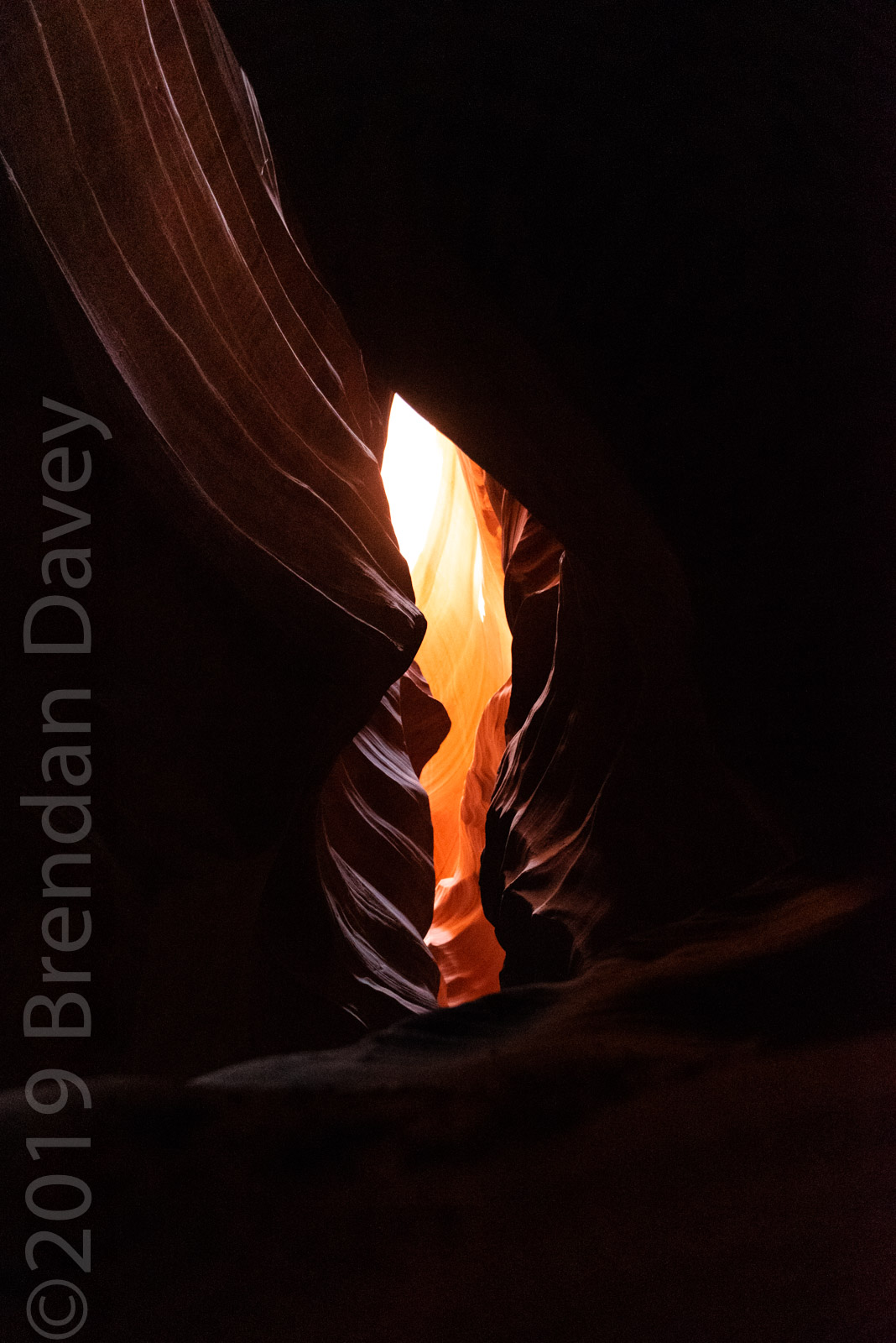
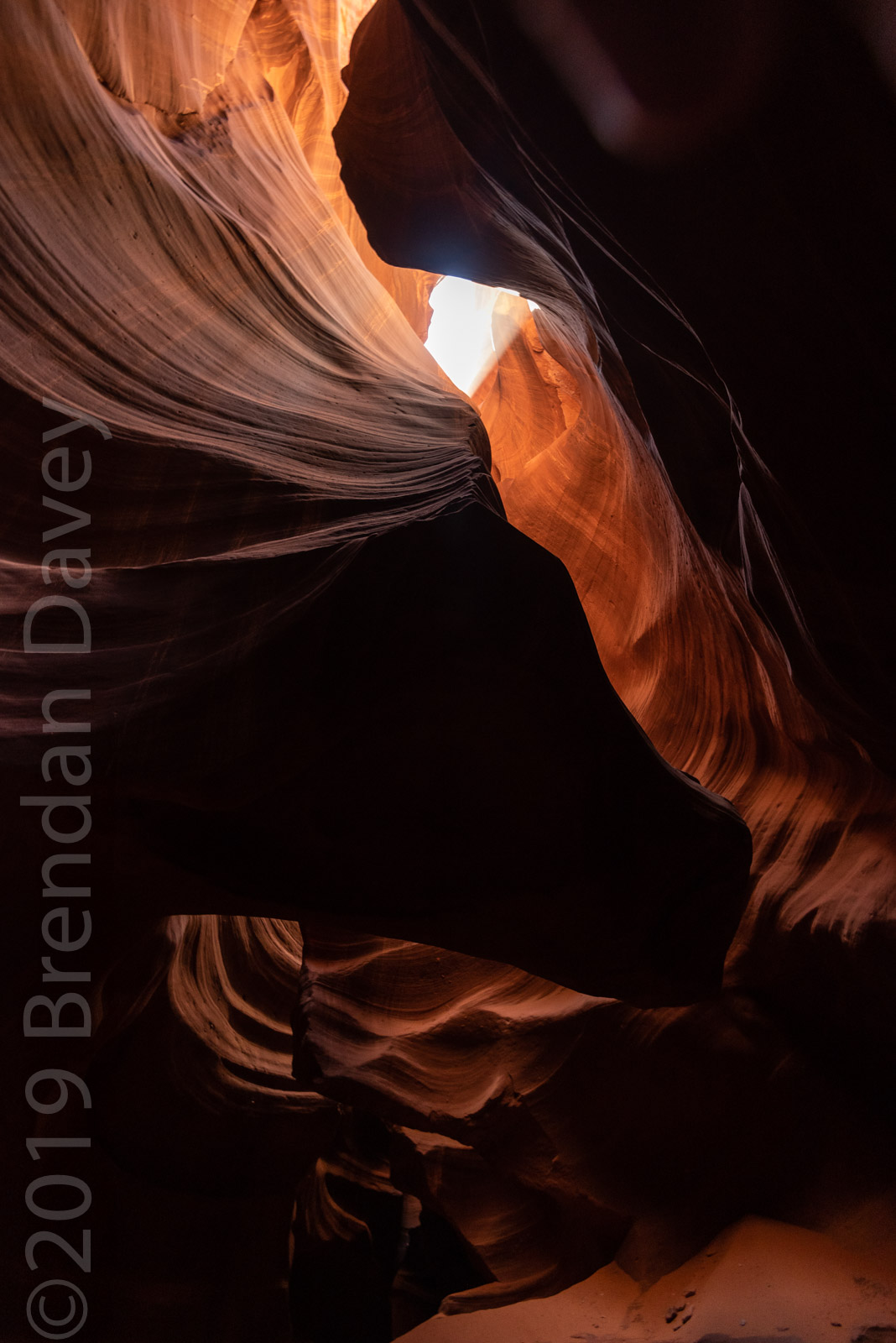
Recently while in the US I had the opportunity to shoot the Upper Antelope Canyon. I was with my wife, who did not have s DSLR at the time, so this ruled out a ‘photography’ tour, as a DSLR + Tripod were required by all those who took the tour. Ditching my wife was not really an option 😉
But to be honest I think the general tour worked out well, sure it was rushed, and you needed to be on your ‘A’ game with a good low light camera to shoot with no tripod, but I think I pulled it off. I managed to snap lots of great shots. I almost felt sorry for the photography group forced to line up their cameras to all catch the exact same shot, often recreating ‘famous’ shots. I was also glad my gear was not sitting on a tripod as the fine sand fell.
The tour guides had a well oiled machine, pushing as many people through the canyon they could. Knowing that I would be moving quite fast with no tripod I had to get the settings roughly right, as there would be little time to play around.
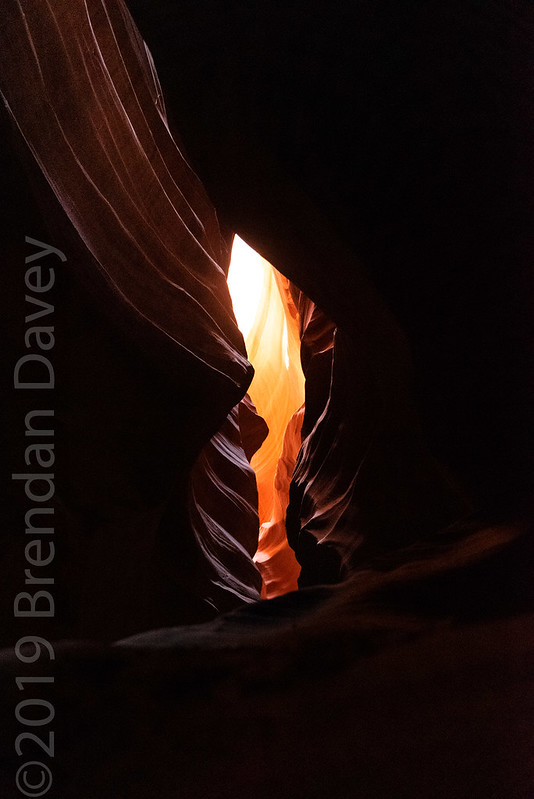
“The Flame”
I decided to just let the camera deal with the ISO so I could at least ensure sharp shots without a tripod. Some of the shots were as high as 12800 ISO and 1/30th @ f4. I had decided that the f4 16-35mm would be the best choice from my kit not having an f2.8 equivalent. The 16-35 was also the best option as I wanted to also use a polariser, as the rock is known to be highly reflective, and this would have been a problem with some of the more wider lenses. Of course the polariser added to the problem, subtracting from what little precious light there was.
Back button focus was a must for quick focus and framing, there was simply not enough time to move the AF point a lot of the time. Occasional exposure compensation adjustment up to -3EV was also used at times. I wanted to retain a lot of the highlights, so underexposure was more important than over, I trusted the D750 and it’s low light power. It also helped to keep the shutter speed to acceptable hand held levels.
Overall the I think the outcome was very good, I was a little dubious when looking at the shots on the camera, but once I pushed the RAW images into Lightroom and corrected to daylight colour they really started to pop.
Maybe, just maybe there is another million dollar shot in the mix. Then again it’s hard to take a bad picture of the Canyon.
“The Sniff”
If you would like to see more of the shots I have uploaded them to flickr.
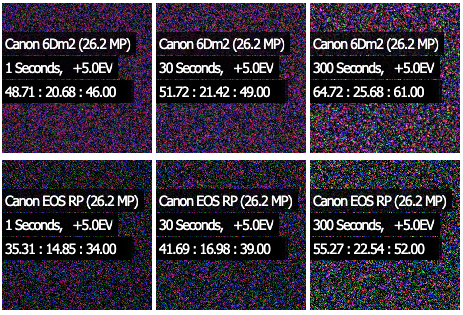
Canon have improved the sensors in the EOS R and RP. The R sensor is based on the same sensor we see in the 5D mark 4, and the RP is based on the same sensor in the 6Dm2 and Canon have managed to squeeze a little more out of both for some good results.
EOS-RP v’s 6D mark II
As you can see the EOS-RP sensor performs much better than the 6Dm2 sensor over the whole range of long exposure times. Canon have possibly continued to improve the manufacturing process or the new DIGIC processing is really working some extra magic. The RP is where I expected the 6Dm2 sensor to be after the fantastic long exposure performance of the original mark I. Better late then never.
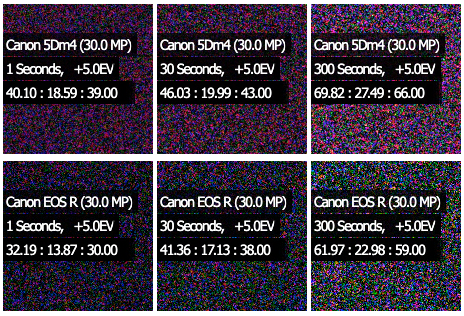
EOS-R v’s 5D Mark IV
The EOS-R is also better than the 5D mark IV. It’s not the same jump in sensor improvement as the RP, but it’s still a big improvement of almost 20% less noise at 1 second. Again there is consistent gains over the long exposure testing range.
So it’s a good gain for Canon, but I do feel disappointed again, just like I did when testing the 6D mark II. Canon are making consistent gains with each new model, but the long exposure sensor noise is where the competition was years ago.
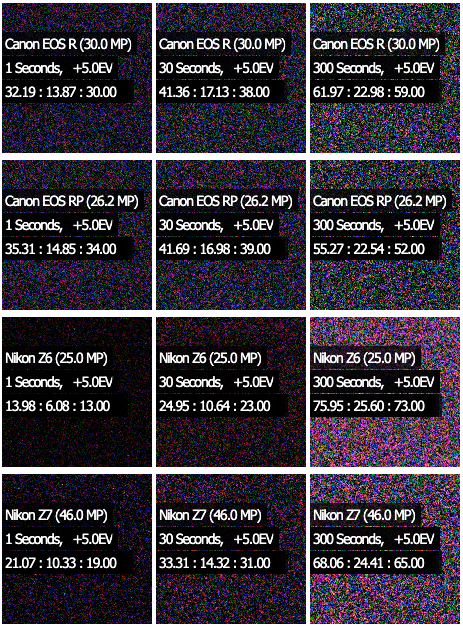
Mirrorless, Nikon and Canon
When comparing the R and RP to the Z6 and Z7 based on long exposure base noise alone It would be difficult to recommend Canon, especially if you are not gear biased. The R/RP may do better for extreme long exposures of 5 mins or more, but how these models would compare with dark frames added to remove noise for extreme long exposure I don’t know.
Conclusion: If you are currently using Canon then the R and RP are a good step up from the 5D mark 4 and 6D mark 2 in regards to sensor noise. If your thinking of upgrading to mirrorless I think both these would perform well and give good results. It’s possibly the most sensible path to go down if you have a lot of EF glass and just want to expand your kit.
The EOS-R has the best long exposure low noise sensor from Canon over 20MP, so if you are after Canon, this is the one to buy. The EOS-RP is also very respectable and not far behind. Will they be the cleanest images money can buy for long exposure?, No I expect not.
If you would like to compare the EOS-R and EOS-RP to more models, or learn more about the sensor database click here.
Again, a big thanks for Alex @Stallards in Hobart for access to these cameras for testing.